
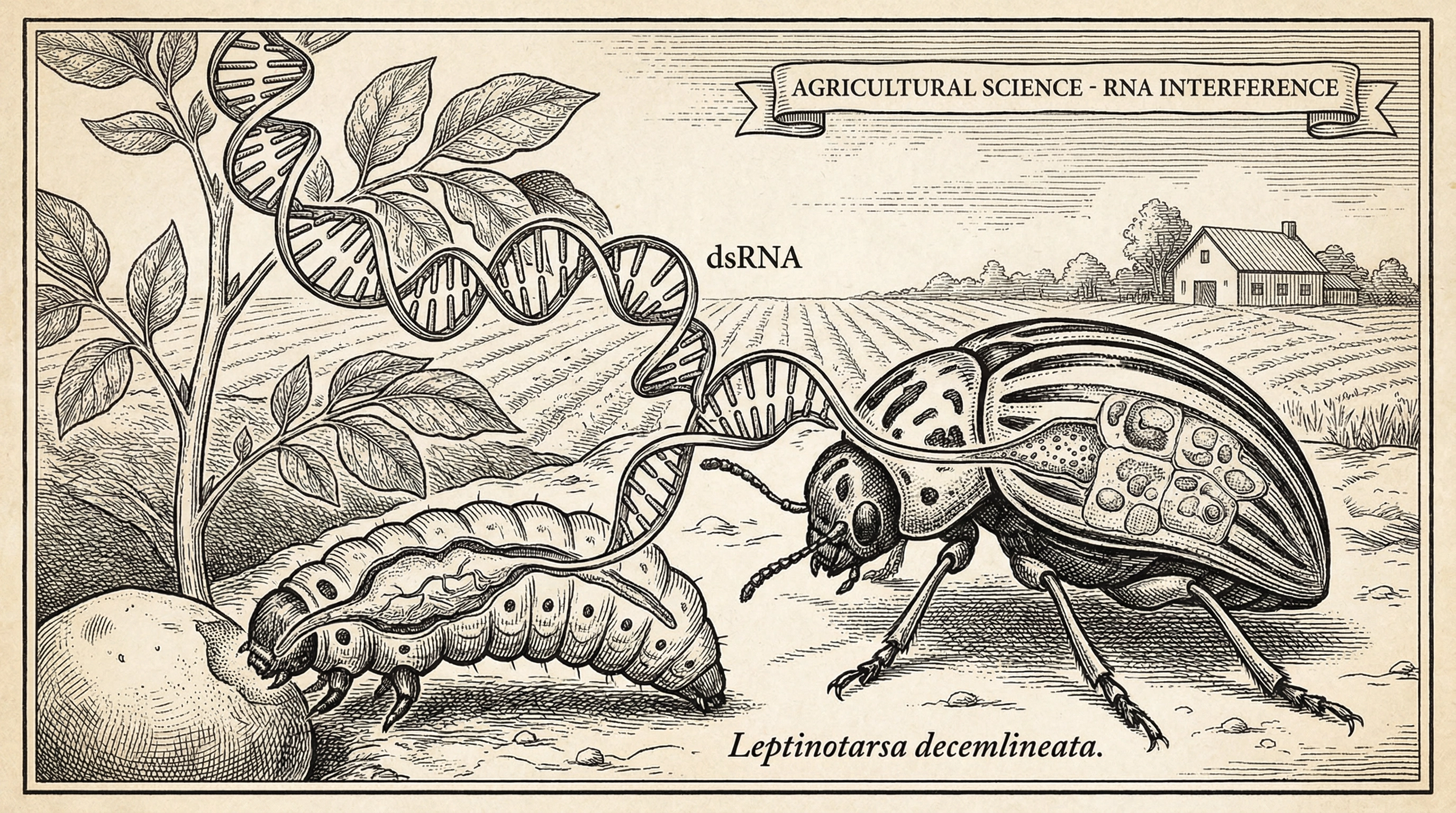
RNAi Insecticides: Evolution in Action
A new class of insecticides based on RNA interference (RNAi) has been approved for global use, marking a paradigm shift in agricultural pest control. However, it also presents a new arena for observing rapid evolutionary adaptation.
Mechanism of Action
Unlike chemical pesticides that target nervous systems, RNAi insecticides use double-stranded RNA (dsRNA) to silence specific essential genes in the target insect. When the insect ingests the dsRNA, its own cellular machinery destroys the corresponding mRNA, effectively turning off a vital gene.
Evolutionary Arms Race
The specificity of RNAi is its greatest strength, but also its evolutionary weakness. Because it relies on exact sequence matching:
- Target Specificity: It harms only the pest, leaving pollinators like bees unaffected.
- Resistance Potential: A single point mutation in the target gene sequence can render the insect immune.
Field studies have already begun to document the emergence of resistance alleles in Colorado potato beetle populations, providing a high-resolution model for studying the dynamics of rapid adaptation under strong selective pressure.