
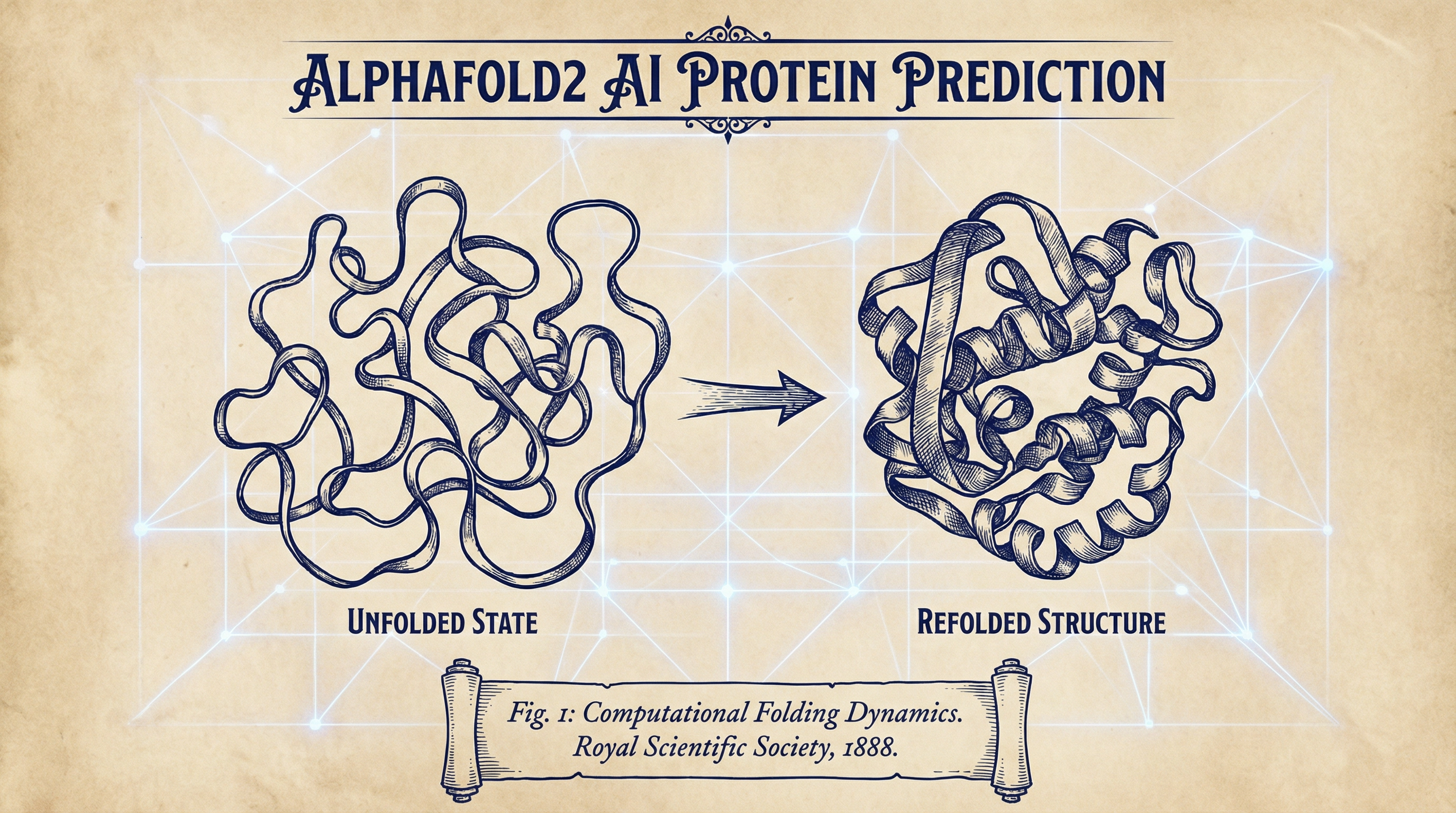
AlphaFold2 Revolution: AI-Driven Protein Structure Prediction
The 2024 Nobel Prize in Chemistry has been awarded to the developers of AlphaFold2, an artificial intelligence system that has solved one of biology's grandest challenges: predicting the 3D structure of proteins from their amino acid sequences.
The Protein Folding Problem
For decades, scientists have known that a protein's function is determined by its three-dimensional shape. However, determining this shape experimentally via X-ray crystallography or cryo-electron microscopy is a laborious, expensive, and time-consuming process. The "protein folding problem"—predicting this structure computationally—has stumped researchers for 50 years.
Enter AlphaFold2
AlphaFold2 utilizes a novel deep learning architecture that incorporates evolutionary information and physical constraints. By analyzing the co-evolution of amino acid residues in multiple sequence alignments, the AI can infer which parts of the protein are in close proximity, effectively folding the protein in silico with near-experimental accuracy.
Evolutionary Implications
For evolutionary biologists, AlphaFold2 is a game-changer. It allows for:
- Structural Phylogenetics: Comparing protein structures across vast evolutionary distances where sequence homology has been lost.
- Ancestral Reconstruction: Predicting the structure of ancient proteins reconstructed from phylogenetic trees.
- Orphan Protein Analysis: Determining the potential function of proteins with no known homologs.
This breakthrough accelerates our ability to map the protein universe, revealing the structural conservation that underlies the diversity of life.